Introducing Confidential Assets on the Polymesh DevNet
For years, institutions exploring real‑world asset (RWA) tokenization have been burdened with a difficult trade‑off: maintain confidentiality in private, walled environments, or move onchain to improve shared-state compliance, auditability, and lifecycle automation at the risk of exposing sensitive positions and flows.
With the launch of Confidential Assets on the new Polymesh DevNet, this trade‑off disappears.
Powered by P-DART, Confidential Assets enables RWA settlement on a shared ledger while keeping participant identities, balances and transaction amounts confidential, with controlled transparency for regulators, auditors, and other designated oversight roles.
We’re delighted to share that Confidential Assets are now live on the Polymesh DevNet, giving builders a dedicated environment for experimentation ahead of testnet and mainnet release.
This milestone release reflects years of research and collaboration between Polymesh Labs and the University of Edinburgh, as well as the broader effort to design privacy that supports regulation rather than working around it.
👉🏼 Start exploring today: https://devnet-confidential.polymesh.dev/
Below is a focused overview of why Confidential Assets matter, what they enable, and how to get started.
Why Confidentiality Matters for Real‑World Assets
Institutions have operational and compliance requirements, and confidentiality is one of them; counterparty exposure, position data, settlement intent, and trade size should remain confidential. At the same time, regulated assets require auditability, enforcement, and control.
Today, most institutional workflows operate offchain because public blockchains reveal information that should remain private:
Positions and flows become visible to the market
Large allocations, redemptions, rebalancing events, or block trades can signal strategy, reveal alpha, and impact pricing.
Order books and OTC workflows don’t map cleanly to transparent ledgers
Pre-trade intent and negotiation are often sensitive and not suitable for public mempools or explorers.
Regulators require controlled transparency; neither total opacity nor total openness
Institutions must protect client confidentiality while ensuring appropriate oversight. Regulators and auditors should have visibility; unknown others should not.
The result is a patchwork of partial solutions – private side letters, bilateral spreadsheets, or fully private ledgers – that fragment liquidity and introduce operational friction.
Polymesh confidentiality addresses this issue from a critical new dimension, unifying privacy, enforceable compliance, and settlement, ultimately letting participants preserve privacy within the comfort of a public, purpose-built blockchain.
What Are Confidential Assets?
In contrast to zero-knowledge L1s, privacy coins, or enterprise permissioned chains, Polymesh confidentiality coexists with compliance and operational control. Confidential Assets represent the evolution over MERCAT, combining encrypted balances, transfer amounts, asset and investor identifiers with Polymesh’s native settlement to enable confidential transactions that remain verifiable, enforceable, and audit-ready. Complex technology; simple delivery.
Learn more about P-DART, the protocol behind Confidential Assets.
Key benefits of Polymesh confidentiality
Smaller Proof sizes
The transaction protocol, purpose-built for financial institutions, uses zero-knowledge proofs tailored for Polymesh workflows. Diverging from generalized zero-knowledge proofs allows P-DART to maintain efficient proofs for higher throughput – a key requirement for real-world financial transactions that rely on speed.
Built-in auditor decryption
Asset issuers can approve auditors or grant other required entities the ability to decrypt transaction details when needed, enabling compliant reporting and dispute resolution without exposing positions to the broader network.
Non-interactive confidential transfers
Transfers can be created and validated without both parties being online or coordinating in real time, supporting asynchronous institutional workflows across systems and timezones.
Reversibility via force transfer support
Errors, legal actions, or mandated corrections can be addressed by the Asset issuer through force transfer support – something most privacy systems cannot provide.
Multi-asset confidential transfers through atomic settlement
Polymesh’s instruction-based settlement engine allows multi-leg, multi-asset transfers to execute atomically, while asset types and positions remain unknown to outside observers.
Together, these capabilities deliver confidential, compliance-ready asset flows on a public permissioned chain – something other privacy solutions cannot offer in combination.
Why debut on a DevNet?
Confidentiality introduces new developer patterns, new cryptographic workflows, and new integration surfaces that interact with existing pallets, such as identity and settlement. Launching on a dedicated DevNet allows for testing of cryptography, auditor flows, mediation, and logic without introducing early instability to broader ecosystem environments.
DevNet is not for production implementations. Instead, it’s a sandbox for experimenting in an environment where iteration speed is high and breaking changes are expected.
Developers can utilize the DevNet to experiment and prototype safely, model real institutional workflows, and shape upcoming testnet and mainnet releases. Teams can build and test full lifecycle flows without operational risk, and early builders have direct influence on final parameters.
Eventually, we’ll roll out confidentiality features to the testnet and then mainnet; for now, we’re excited to offer the DevNet for users to integrate, experiment, and prepare long before Confidential Assets is production-ready.
What Can You Build? Key Use Cases
Confidential Assets supports onchain workflows where positions, flows, or transactions must remain private. Early examples include:
Tokenized Private Assets (e.g. private equity; private debt)
Settle private securities – such as private equity or private credit – while keeping investor allocations, transaction amounts, and asset movements confidential, with rights-based visibility enabling controlled auditor or mediator access.
Learn more about Polymesh tokenization for equity and debt.
Privately negotiated trading (OTC and RFQ workflows)
Support negotiated transactions – such as OTC (over-the-counter) agreements or RFQ (request-for-quote) processes – with confidential transaction sizes and private positions. Settlement remains fully onchain using atomic delivery‑versus‑payment.
Tokenized Funds & Structured Products
Issue confidential fund units or structured products where investor holdings and activity are kept private, yet administrators and regulators retain required insight. Lifecycle events such as subscriptions and redemptions still settle securely onchain.
Dark Pools & Block Trades
For large trades that may move markets if exposed too early, Polymesh’s confidentiality functionality brings much-needed privacy. Venues can match and execute trades privately while ensuring final movement of assets remains atomically onchain and auditable.
These use cases represent only the starting point; the DevNet is designed to support a wide range of institutional privacy‑preserving workflows.
Who Should Join the DevNet?
The DevNet is built for anyone looking to interact and experiment with Confidential Assets on Polymesh. This may include:
- custodians and trust companies exploring confidential settlement and safekeeping;
- exchanges, broker-dealers, and alternative trading systems building private or semi-private workflows onchain;
- tokenization platforms and RWA issuers designing private or hybrid asset structures;
- DeFi and onchain credit protocols integrating regulated, private markets into protocol designs;
- Infrastructure and middleware providers adding support for confidential balances or transfers.
In short, the DevNet is designed for developers and businesses looking to move workflows onchain that involve sensitive market data.
Getting started with the Polymesh DevNet
We invite developers, custodians, market operators, and ecosystem partners to begin integrating and experimenting on DevNet, accessible at https://devnet-confidential.polymesh.dev/.
In addition, we recommend the following resources for assistance:
1. Sign up for DevNet and developer updates
Sign up on the Polymesh Confidentiality page to receive future access details, such as planned testnet or mainnet rollouts.
Developers should also sign up for Developer Updates to get notified of any future chain updates that may include breaking changes.
2. Review the documentation
Get a high-level overview on the Polymesh Confidentiality page, or dive deeper with the:
- technical paper, detailing how P-DART extends the DART protocol to Polymesh
- Github repo containing the code for P-DART
3. Connect with the developer tooling
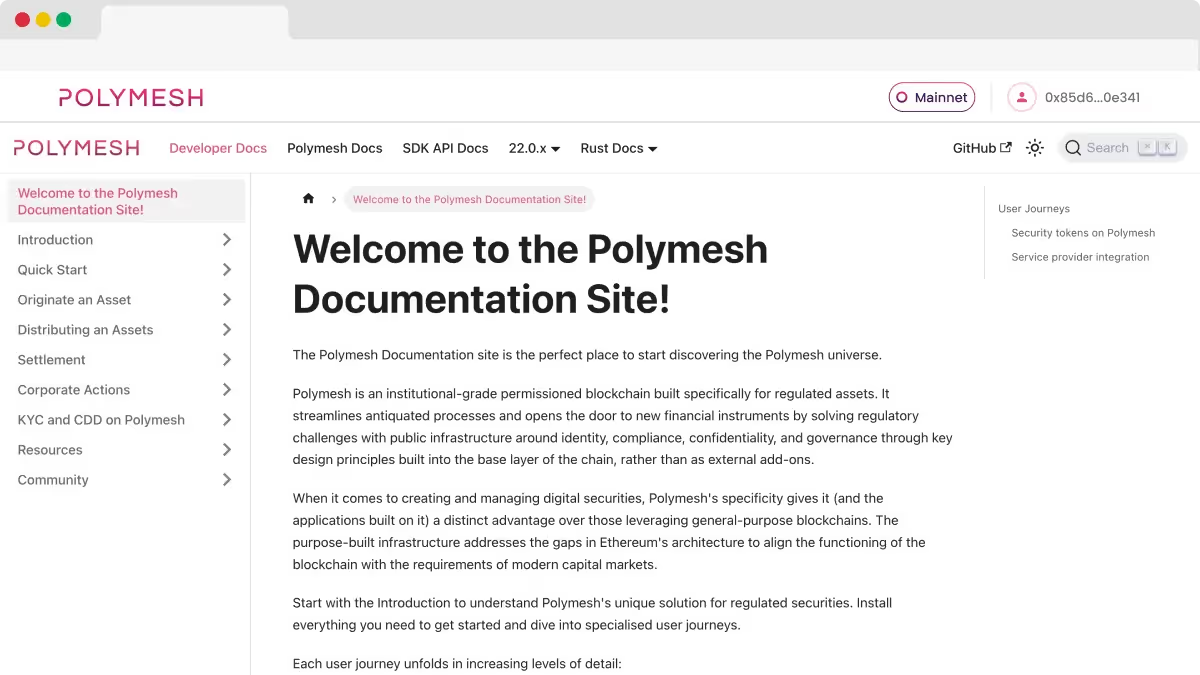
Discover available tooling in the Developer Portal: the SDK, REST API, and other functionality for building end-to-end encrypted workflows.
4. Share your feedback
Early builders directly influence the roadmap. Tell us what works, what doesn’t, and what you need next. Get in touch with us at [email protected] or by joining the Polymesh Discord.
Confidential Assets on the Polymesh DevNet open the door to tokenized private markets on public blockchain infrastructure, uniting privacy with enforceable compliance and settlement at the base layer.
DevNet is now live. Access it now at https://devnet-confidential.polymesh.dev/.
We’re excited to see what you build.
The Polymesh Developer Portal is contains comprehensive documentation, specialized user journeys, and hands-on exercises for building on the purpose-built Polymesh network.