Polymesh v8 Coming to Testnet on June 24th and Mainnet on July 22nd
The Polymesh v8 upgrade is approaching and will introduce some of the most significant changes to the network since launch.
We are currently targeting the following rollout schedule:
Testnet: 24 June 2026
Mainnet: 22 July 2026
Polymesh v8 focuses on simplifying onboarding, reducing transaction friction, expanding asset ownership models, and improving compatibility with broader blockchain tooling, while maintaining the flexibility required by regulated asset ecosystems.
This release also includes a substantial upgrade of the underlying blockchain framework and modules to Polkadot SDK version stable2603-2.
Taken together, these changes represent an important evolution of the platform. The release removes several sources of friction that have historically impacted users and developers while introducing new capabilities that expand how applications can be built on Polymesh.
Who Should Read This?
This upgrade is particularly relevant for:
- Developers
- Integrators
- Infrastructure Operators
- Asset Issuers
- Wallet Providers
At a Glance
Polymesh v8 introduces:
- Self-registered DIDs, no CDD Claim required
- DID Registrars replacing CDD Providers
- Receiver affirmations become opt-in
- Expanded account-based ownership for assets and NFTs
- Asset allowances and delegated spending
- EVM smart contract support via PolkaVM and Revive
- Generic Polkadot Ledger app support
- Confidential Assets available on Testnet
- Upgrade to Polkadot SDK stable2603-2
Infrastructure Releases Available Now
Node binaries and Docker images for v8.0.0 are already available. Nodes can be upgraded ahead of the runtime upgrade, allowing infrastructure operators to begin preparation immediately.
Node Release
https://github.com/PolymeshAssociation/Polymesh/releases/tag/v8.0.0
Docker Images
https://hub.docker.com/r/polymeshassociation/polymesh/tags?name=8.0.0
Infrastructure operators are strongly encouraged to upgrade and begin testing as soon as possible.
Simpler Identity Onboarding
One of the biggest changes in v8 is a new approach to identity registration.
Historically, users joining Polymesh were required to obtain a DID through a CDD Provider, complete identity verification, and receive a CDD Claim before participating on the network. While this model established a trusted identity framework, it also introduced onboarding friction for users and developers.
In practice, asset issuers and applications still needed to perform their own onboarding and KYC processes to satisfy regulatory requirements. This often resulted in users completing multiple onboarding flows before they could begin using an application.
Polymesh v8 removes the requirement for CDD Claims and allows users to self-register DIDs directly on-chain.
CDD Providers are being migrated to a new DID Registrar model. Permissioned DID Registrars can continue to register identities on behalf of users, while users who do not require a registrar can create identities directly.
The result is a significantly simpler onboarding experience while retaining flexibility for institutions and applications that wish to manage identity registration workflows.
Simpler Asset Transfers
Another major change in v8 is the transfer affirmation model.
Historically, transfers required receiver affirmations by default, adding additional steps before assets could settle. While this helps prevent unwanted transfers, it also adds friction to the transfer flow.
In v8, receiver affirmations are disabled by default for all users.
Users can still require receiver affirmations when needed by enabling them, but the default experience is now significantly simpler and more closely aligned with user expectations from other blockchain ecosystems.
This reduces friction while preserving the ability to enforce additional controls when necessary.
Important: Applications that assume all transfers require receiver approval should review their transfer flows before the chain is upgraded.
Expanded Account Based Asset Ownership
Polymesh v7.4 introduced support for account based native asset balances as an alternative to traditional portfolio based ownership.
Polymesh v8 extends this model to support NFTs, introduces a new settlement.transferFunds method, removes the need to specify a DID in addition to an account address, and simplifies the account based settlement flow.
Identity owned portfolios remain fully supported and continue to be the preferred model for many institutional workflows where share control via secondary keys is required. However, developers can now choose between portfolio based and account based ownership models depending on their application requirements.
The Polymesh Portal has been updated accordingly, with the Portfolio page evolving into a Balances experience that supports both portfolios and accounts, and the Transfers page supporting account based transfers.
Asset Approvals and Delegated Spending
v8 introduces approval based allowances for key held assets.
This allows an account holder to authorize another account or smart contract to transfer assets on its behalf within defined limits. Without an allowance, only the account key holder can transfer assets associated with that key.
These delegated spending capabilities enable new application patterns and align Polymesh more closely with workflows commonly found across the broader blockchain ecosystem, such as ERC20 style tokens.
Allowances work in conjunction with the new settlement.transferFunds method.
EVM Smart Contract Support
Polymesh v8 introduces EVM compatibility through PolkaVM and the Revive pallet.
Developers can build Solidity based smart contracts while continuing to leverage Polymesh identity and asset infrastructure.
This opens the door to a broader range of developer tooling and application architectures while maintaining access to Polymesh specific functionality.
Hardware Wallet and Ledger Support Updates
With v8, Polymesh will also support the generic Polkadot Ledger application as well as the Polkadot Migration app, expanding hardware wallet compatibility across the ecosystem.
At Mainnet launch, the existing Polymesh Ledger application will be updated to a Polymesh branded version of the generic Polkadot app, while continuing to use the Polymesh specific key derivation path to ensure compatibility with existing accounts.
The Polymesh wallet extension has already been updated to support all three wallet options.
These generic Ledger applications use a metadata hash based approach, enabling support for clear signing of current and future transaction types without requiring frequent application updates as the runtime evolves.
Confidential Assets on Testnet
Polymesh v8 also introduces Confidential Assets, as previously previewed on Devnet, to Testnet.
This functionality enables counterparty privacy, asset confidentiality, and balance confidentiality while maintaining the compliance and auditability requirements expected of regulated assets.
Confidential Assets will be available for experimentation and feedback on Testnet but will remain disabled on Mainnet while additional development, testing, and auditing activities continue.
This Testnet release allows developers and ecosystem participants to begin exploring the functionality and providing feedback ahead of a future Mainnet activation.
Look out for more information on Polymesh Confidential Assets in the coming weeks.
Required Software Versions
Developers and integrators should begin preparing to upgrade to:
- Polymesh v8.0.0
- polymesh-sdk v30.0.0
- polymesh-types v7.4.0
- polymesh-subquery v19.6.0
- polymesh-rest-api v8.1.0-alpha.1 or newer
The SDK release is compatible with both the current network and v8, allowing applications to begin preparing before the upgrade.
What Happens Next?
In the coming days and weeks we will publish:
- Migration guidance
- Updated documentation
- Infrastructure upgrade guidance
- Updated Confidential Assets documentation
We encourage all developers, integrators, infrastructure operators, and ecosystem participants to begin testing against Testnet as soon as it becomes available.
If you have any questions, please reach out via Discord or our support channels.
Thank you to everyone who has contributed feedback, testing, and development throughout the v8 cycle.
We look forward to seeing what the community builds with Polymesh v8.
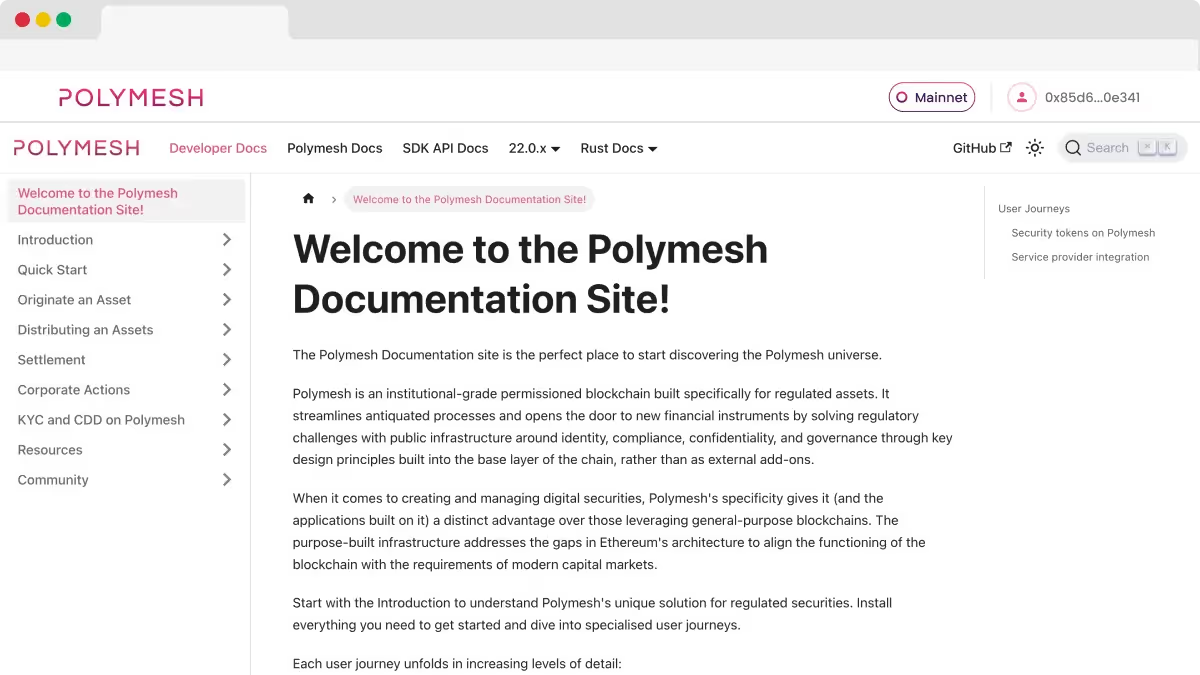
The Polymesh Developer Portal is contains comprehensive documentation, specialized user journeys, and hands-on exercises for building on the purpose-built Polymesh network.