Polymesh 8.1.3 is live on mainnet: every asset now has an EVM address
Polymesh mainnet has upgraded from version 8.0.2 to 8.1.3. It's the first 8.1 release to reach mainnet, so it brings everything we've shipped to testnet over the past few months (8.1.0 through 8.1.3) in a single upgrade.
The headline: every asset on Polymesh can now be used directly from EVM smart contracts and Ethereum tooling. Issuers also get much finer control over freezing. Compliance applies to every transfer, whichever route it takes.
Every Polymesh asset now has an EVM address
Polymesh 8.0 brought EVM smart contracts to the chain. 8.1 connects those contracts to the assets that already live here.
Each fungible asset now appears as an ERC-20 token at its own address, and each NFT collection appears as an ERC-721. There's nothing to deploy, no registry to sign up to, and issuers don't need to opt in. If an asset exists on Polymesh, it already has an EVM address.
For builders, that means wallets, dApps and developer tools written for Ethereum can read balances and move Polymesh assets with far less custom work than before.
What hasn't changed matters just as much. An EVM call runs through the same chain logic as a native Polymesh transaction, so identity checks, compliance rules, transfer restrictions and agent permissions all still apply. If a transfer breaks a rule, it reverts. Using the EVM doesn't let anyone skip the rules.
A third precompile, Polymesh Runtime, lets contracts create assets, register tickers, onboard identities and authorize agents.
The fungible asset interface also includes a set of methods from ERC-3643 and ERC-7943, two standards designed for permissioned tokens. Contracts can pause an asset, freeze an address, freeze part of a balance, and check whether an address is able to send or receive. Neither standard is implemented in full, and the developer docs spell out exactly what's covered.
Freeze one holder, not the whole asset
Until now, freezing an asset on Polymesh meant freezing all of it. With 8.1, issuers can freeze a single holder (an account or a portfolio), or lock just part of a holder's balance and leave the rest usable.
That covers situations that used to need blunt workarounds: a legal hold on one investor's position, a transfer under dispute, or tokens that should stay locked until a vesting date.
Freezes are enforced everywhere tokens can move, including settlement, portfolio transfers, STOs and capital distributions. The pre-transfer checks that wallets use to tell users whether a transfer will succeed take freezes into account as well.
Approvals for NFTs
NFT holders can now approve someone else to move a specific token, or approve an operator for an entire collection. It follows the familiar ERC-721 approve and setApprovalForAll model, and works both natively and through the NFT precompile. Approvals also carry through to settlement, so an approved party can move an NFT on the holder's behalf.
Better support for Ethereum wallets
- Ethereum keys can now be MultiSig signers.
- The Relayer can subsidize EVM accounts, so a business can cover fees, including the storage deposit, for users who hold Ethereum wallets.
- Accepting an authorization from an Ethereum wallet is free, the same as it already was for Substrate keys.
Tighter checks across the board
The 8.1.2 and 8.1.3 releases focused on correctness rather than new features. Permission checks for secondary keys and MultiSigs are stricter, compliance rules and settlement affirmations get more validation, NFT controller transfers emit dedicated events that indexers can track, and transaction weights have been re-benchmarked so fees better reflect actual cost.
What you need to do
POLYX and asset holders: nothing. Balances, assets and identities carry over automatically.
Exchanges, custodians, indexers and SDK integrators: this release adds new extrinsics, events and errors. The transaction version hasn't changed, so signing isn't affected, but you should regenerate metadata-derived code and update any transfer pre-checks to account for holder-level freezes.
Developers: start with the precompile pages in the developer docs.
The full list of changes, plus a step-by-step migration checklist, is in the v8.0 to v8.1.3 changelog.
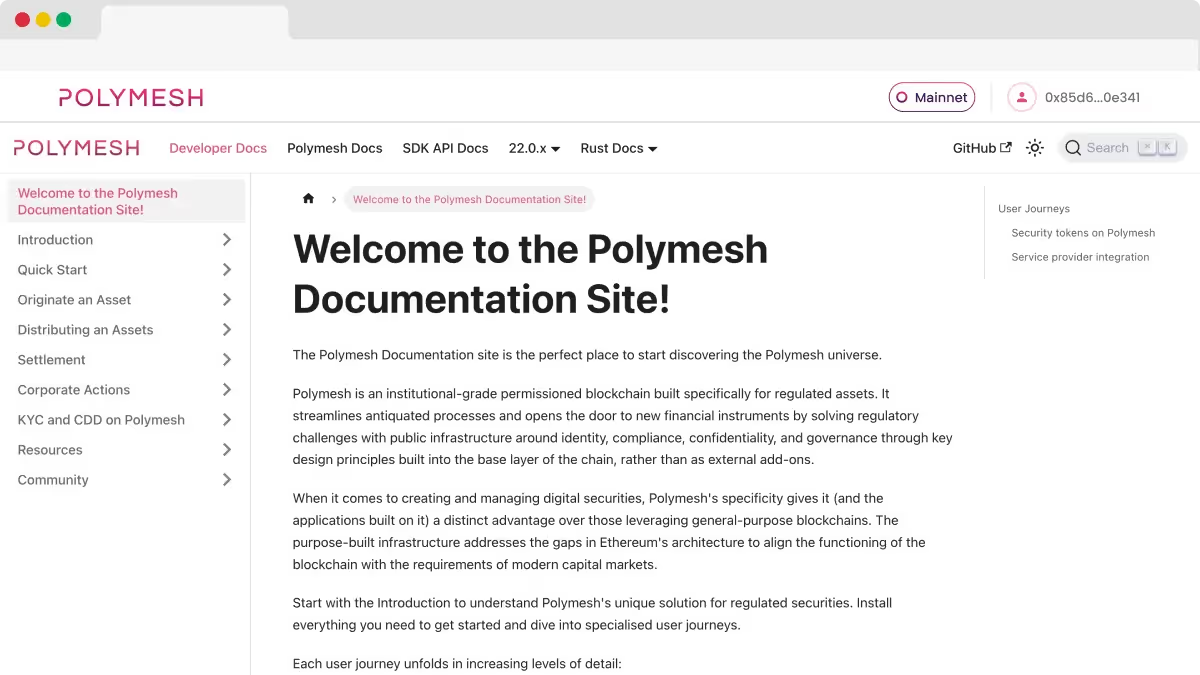
The Polymesh Developer Portal is contains comprehensive documentation, specialized user journeys, and hands-on exercises for building on the purpose-built Polymesh network.